ATOC 4815/5815

Grids & Regridding II: Conservation, Diagnostics & Tools — Week 9b

Will Chapman

CU Boulder ATOC

Spring 2026

Grids & Regridding II

Recap: What Did You Find?

End of last class, we left you with a question:

You have daily IMERG precipitation at 0.1°. You want to compare it to CESM2 at 1°. Which regridding method would you use and why?

The answer:

Precipitation accumulation is an extensive variable — it represents a total amount over each grid cell area. If you bilinearly interpolate to a coarser grid, you will change the total precipitation in your domain.

You need conservative remapping — which preserves the area-integrated total.

Today we build the math, show the consequences of getting it wrong, and introduce the tool that handles it correctly.

Today’s Objectives

  • Understand why conservation fails with bilinear interpolation
  • Derive first-order conservative remapping from first principles
  • Diagnose regridding errors (mass, mean, extremes)
  • Use xESMF for production-quality conservative regridding
  • Know the software engineering patterns for working with large grids
  • Practice: compare methods on a precipitation field and quantify the error

Why Conservation Matters

EX: Water Budget

Consider a regional domain. The area-integrated total precipitation is:

\[M = \int_A f \, dA \approx \sum_i f_i \, A_i\]

where \(f_i\) is the precipitation rate and \(A_i\) is the area of cell \(i\).

What happens when you bilinearly interpolate daily precipitation to a coarser grid?

import numpy as np
import xarray as xr

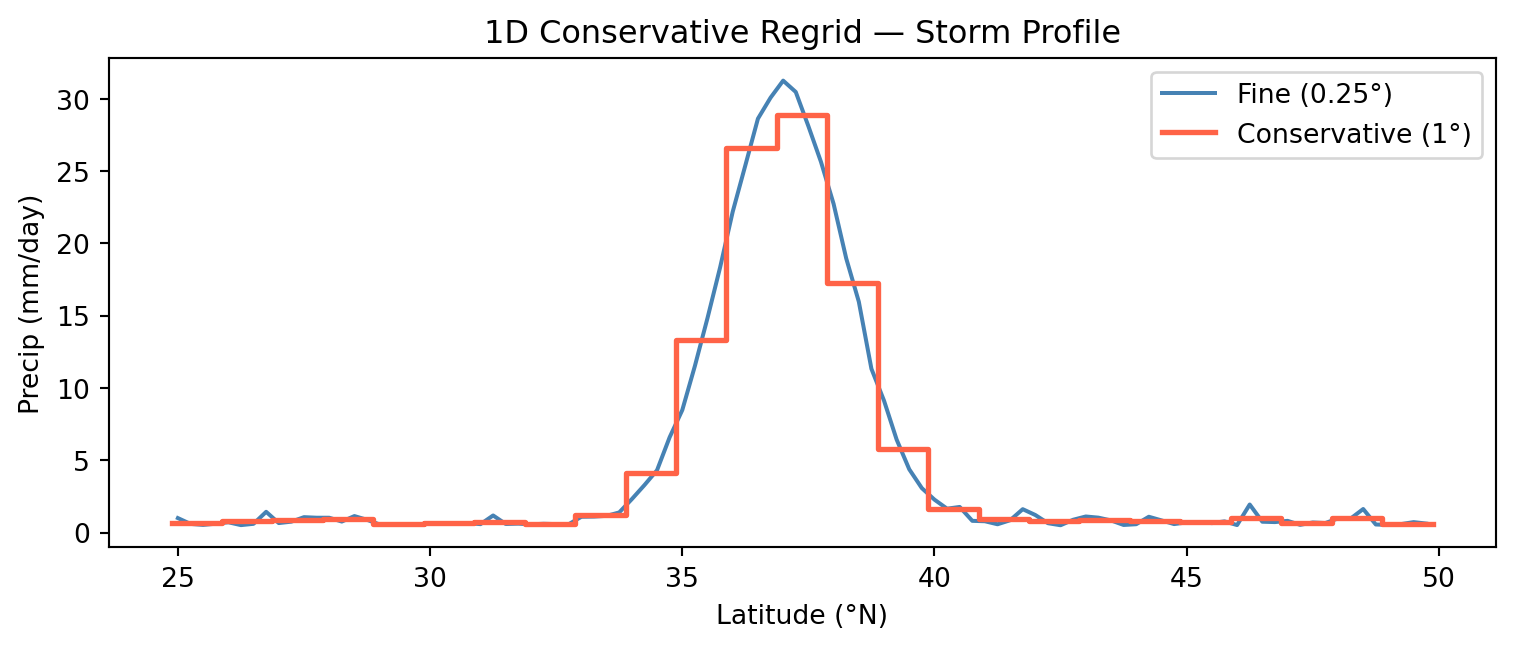
# Synthetic precip field: concentrated storm, fine grid (0.25°)
rng = np.random.default_rng(42)
lats = np.arange(25, 50, 0.25)
lons = np.arange(-120, -70, 0.25)
LON, LAT = np.meshgrid(lons, lats)

# A realistic precipitation pattern: concentrated storm + background
storm = 20 * np.exp(-((LAT - 38)**2 / 4 + (LON + 100)**2 / 4))
background = 1.0 + rng.exponential(0.5, storm.shape)
precip = storm + background  # mm/day

ds = xr.Dataset(
    {'precip': (['lat','lon'], precip, {'units': 'mm/day'})},
    coords={'lat': lats, 'lon': lons}
)

# Compute area weights for the fine grid
weights_fine = np.cos(np.radians(ds.lat))

# Total precipitation (area-weighted sum, proportional to mass)
total_fine = float((ds['precip'] * weights_fine).sum())
print(f"Fine grid (0.25°) area-weighted total: {total_fine:,.1f}")
Fine grid (0.25°) area-weighted total: 26,794.8

Mass Loss from Bilinear Interpolation

import numpy as np
import xarray as xr

rng = np.random.default_rng(42)
lats = np.arange(25, 50, 0.25)
lons = np.arange(-120, -70, 0.25)
LON, LAT = np.meshgrid(lons, lats)
storm = 20 * np.exp(-((LAT - 38)**2 / 4 + (LON + 100)**2 / 4))
background = 1.0 + rng.exponential(0.5, storm.shape)
precip = storm + background
ds = xr.Dataset({'precip': (['lat','lon'], precip, {'units': 'mm/day'})},
                coords={'lat': lats, 'lon': lons})

weights_fine = np.cos(np.radians(ds.lat))
total_fine = float((ds['precip'] * weights_fine).sum())

# Regrid to 1° using bilinear
lats_c = np.arange(25.5, 50, 1.0)
lons_c = np.arange(-119.5, -70, 1.0)
ds_bil = ds.interp(lat=lats_c, lon=lons_c)

weights_coarse = np.cos(np.radians(ds_bil.lat))
total_bil = float((ds_bil['precip'] * weights_coarse).sum())

print(f"Fine grid total:      {total_fine:,.1f}")
print(f"Bilinear total:       {total_bil:,.1f}")
print(f"Mass error:           {(total_bil - total_fine)/total_fine * 100:.1f}%")
print(f"Peak fine grid:       {float(ds['precip'].max()):.2f} mm/day")
print(f"Peak bilinear:        {float(ds_bil['precip'].max()):.2f} mm/day")
Fine grid total:      26,794.8
Bilinear total:       1,682.3
Mass error:           -93.7%
Peak fine grid:       21.72 mm/day
Peak bilinear:        19.30 mm/day

Warning

This is not a bug — it is an inherent property of bilinear interpolation. For precipitation, this error is physically unacceptable. In a climate model, this would appear as a systematic bias in the water cycle.

Physical Consequences

When you use the wrong method for extensive variables:

  • Water budget doesn’t close — precipitation minus evaporation minus runoff ≠ ΔStorage
  • Energy imbalance — radiative fluxes that should balance introduce a spurious heat source or sink
  • Climate biases in model evaluation — your model looks better or worse than it actually is, depending on regridding direction
  • Trend analysis errors — if your domain changes resolution over time, trends in totals are artificial

These are not edge cases. They appear in published papers. Knowing this makes you a more careful scientist.

First-Order Conservative Remapping

The Key Idea: Area Overlap

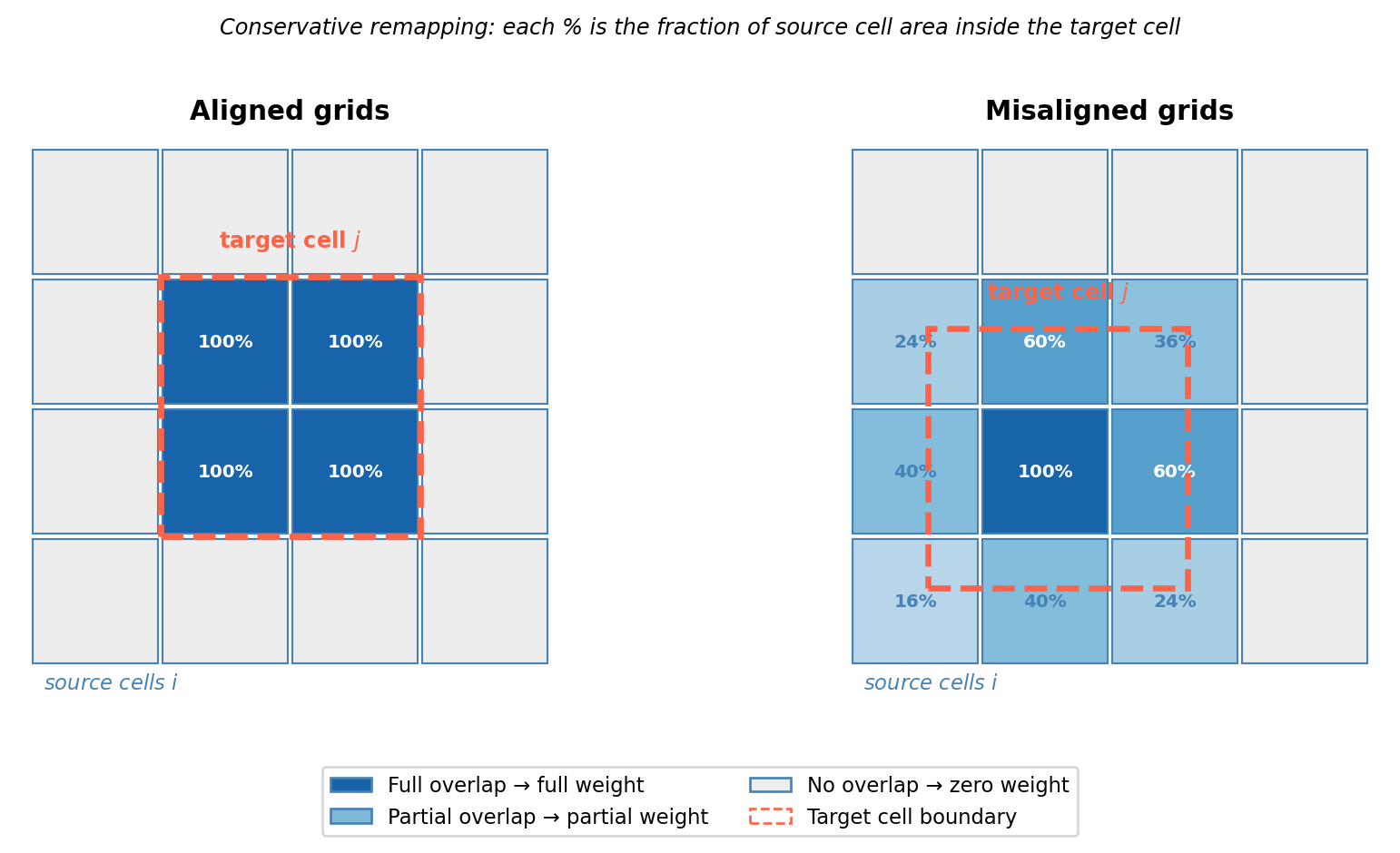
Instead of estimating a value at a point, we ask:

What fraction of each source cell overlaps with each target cell?

The remapping equation:

\[F_j = \frac{1}{A_j} \sum_i f_i \, A_{ij}\]

Where:

  • \(f_i\) = value in source cell \(i\)
  • \(F_j\) = value in target cell \(j\)
  • \(A_{ij}\) = overlap area between source cell \(i\) and target cell \(j\)
  • \(A_j\) = total area of target cell \(j\)

This is an area-weighted average of all source cells that overlap with the target cell.

Conservation check:

Multiply both sides by \(A_j\) and sum over all target cells:

\[\sum_j F_j A_j = \sum_j \sum_i f_i A_{ij}\]

Since \(\sum_j A_{ij} = A_i\) (source cell area equals sum of its overlaps):

\[\sum_j F_j A_j = \sum_i f_i A_i \checkmark\]

The integral is exactly preserved.

A Simple Manual Example

Imagine a 1D case: source grid at 2° spacing, target grid at 3° spacing.

import numpy as np

# Source: 2° cells, 6 cells covering [0, 12]
# Target: 3° cells, 4 cells covering [0, 12]  ← same domain, different resolution
src_centers = np.array([1, 3, 5, 7, 9, 11], dtype=float)
src_edges   = np.array([0, 2, 4, 6, 8, 10, 12], dtype=float)
f_src       = np.array([4.0, 1.0, 8.0, 2.0, 6.0, 3.0])  # e.g. precip mm/day

tgt_edges = np.array([0, 3, 6, 9, 12], dtype=float)
tgt_centers = 0.5 * (tgt_edges[:-1] + tgt_edges[1:])

F_tgt = np.zeros(len(tgt_centers))

for j, (t0, t1) in enumerate(zip(tgt_edges[:-1], tgt_edges[1:])):
    total_weight = 0.0
    for i, (s0, s1) in enumerate(zip(src_edges[:-1], src_edges[1:])):
        overlap = max(0, min(s1, t1) - max(s0, t0))
        F_tgt[j] += f_src[i] * overlap
        total_weight += overlap
    F_tgt[j] /= total_weight

total_src = np.sum(f_src * np.diff(src_edges))
total_tgt = np.sum(F_tgt * np.diff(tgt_edges))
print(f"Source cells: {f_src}")
print(f"Target cells: {np.round(F_tgt, 3)}")
print(f"Source total: {total_src:.2f}")
print(f"Target total: {total_tgt:.2f}")
print(f"Conservation error: {abs(total_tgt - total_src)/total_src * 100:.6f}%")
Source cells: [4. 1. 8. 2. 6. 3.]
Target cells: [3.    5.667 3.333 4.   ]
Source total: 48.00
Target total: 48.00
Conservation error: 0.000000%

From 1D to 2D: Why Software Matters

In 2D (lat/lon), computing overlap areas for every pair of source/target cells is expensive:

  • A global 0.1° → 1° regrid: 1,296,000 source cells × 64,800 target cells
  • Most pairs have zero overlap — use sparse matrices

The weight matrix:

\[w_{ij} = \frac{A_{ij}}{A_j}\]

This is computed once and stored as a sparse matrix. Applying the regridding is then just:

\[\mathbf{F} = \mathbf{W} \mathbf{f}\]

Matrix-vector multiplication — fast even for global grids.

This is exactly what xESMF does:

import xesmf as xe

# Define regridder once
regridder = xe.Regridder(ds_fine, ds_coarse, method='conservative')

# Apply to any number of variables — reuses the weights
ds_regridded = regridder(ds_fine)

Weights are cached and can be saved to disk. You never recompute them.

Conservative Regridding with xESMF

xESMF: The Production Tool

xESMF (xarray Earth System Modeling Framework) wraps the ESMF regridding library with an xarray-native interface.

pip install xesmf
# or
conda install -c conda-forge xesmf

Supported methods:

Method xESMF string Use case
Nearest neighbor 'nearest_s2d' Masks, categorical
Bilinear 'bilinear' Temperature, wind
Conservative 'conservative' Precipitation, fluxes
Patch 'patch' Higher-order smooth
import xesmf as xe

# Step 1: Define regridder (slow — computes weights)
regridder = xe.Regridder(ds_source, ds_target, method='conservative')

# Step 2: Apply (fast — sparse matrix multiply)
ds_out = regridder(ds_source['precip'])

# Step 3: Save weights for reuse
regridder.to_netcdf('weights_conservative.nc')

# Later: reload weights (skip step 1)
regridder = xe.Regridder(ds_source, ds_target, method='conservative',
                          weights='weights_conservative.nc')

xESMF requires cell bounds

Conservative regridding needs to know cell edges, not just centers. xESMF expects lat_b and lon_b arrays (bounds).

import numpy as np
import xarray as xr

def add_bounds(ds, dlat, dlon):
    """Add lat_b and lon_b (cell boundaries) to a dataset."""
    lat_b = np.append(ds.lat.values - dlat/2,
                      ds.lat.values[-1] + dlat/2)
    lon_b = np.append(ds.lon.values - dlon/2,
                      ds.lon.values[-1] + dlon/2)
    ds = ds.assign_coords(lat_b=('lat_b', lat_b),
                          lon_b=('lon_b', lon_b))
    return ds

# Example: 0.25° ERA5 dataset
ds_fine = add_bounds(ds_fine, dlat=0.25, dlon=0.25)

# Now xESMF can compute exact cell overlap areas
regridder = xe.Regridder(ds_fine, ds_coarse, method='conservative')

Note

For regular lat/lon grids, bounds are trivial to compute. For unstructured grids, you need the actual boundary polygons.

All Three Methods on Precipitation

import numpy as np
import xarray as xr
import matplotlib.pyplot as plt

rng = np.random.default_rng(42)
lats_f = np.arange(25, 50, 0.25)
lons_f = np.arange(-120, -70, 0.25)
LON, LAT = np.meshgrid(lons_f, lats_f)
storm = 20 * np.exp(-((LAT-38)**2/4 + (LON+100)**2/4))
precip = storm + 1.0 + rng.exponential(0.5, storm.shape)
ds_fine = xr.Dataset({'precip': (['lat','lon'], precip, {'units':'mm/day'})},
                     coords={'lat': lats_f, 'lon': lons_f})

lats_c = np.arange(25.5, 50, 1.0)
lons_c = np.arange(-119.5, -70, 1.0)
ds_nn  = ds_fine.sel(lat=lats_c, lon=lons_c, method='nearest')
ds_bil = ds_fine.interp(lat=lats_c, lon=lons_c)

# Manual conservative (area-weighted block average — approximates xESMF conservative)
def block_conservative(ds_src, lats_tgt, lons_tgt, src_dlat=0.25, src_dlon=0.25):
    out = np.zeros((len(lats_tgt), len(lons_tgt)))
    for j, lt in enumerate(lats_tgt):
        for i, ln in enumerate(lons_tgt):
            mask_lat = (ds_src.lat >= lt - 0.5) & (ds_src.lat < lt + 0.5)
            mask_lon = (ds_src.lon >= ln - 0.5) & (ds_src.lon < ln + 0.5)
            sub = ds_src['precip'].isel(lat=mask_lat, lon=mask_lon)
            wts = np.cos(np.radians(ds_src.lat.values[mask_lat]))
            if sub.size > 0:
                out[j, i] = np.average(sub.values, weights=wts[:, None] * np.ones(sub.shape))
    return out

cons_vals = block_conservative(ds_fine, lats_c, lons_c)
ds_cons = xr.Dataset({'precip': (['lat','lon'], cons_vals, {'units':'mm/day'})},
                     coords={'lat': lats_c, 'lon': lons_c})

# Cell area ∝ cos(lat) * dlat * dlon — must include grid spacing or
# the fine grid (16× more cells) will give a 16× larger domain sum.
dlat_f, dlon_f = 0.25, 0.25
dlat_c, dlon_c = 1.0,  1.0
w_f = np.cos(np.radians(ds_fine.lat)) * dlat_f * dlon_f
w_c = np.cos(np.radians(ds_nn.lat))   * dlat_c * dlon_c
t_fine = float((ds_fine['precip'] * w_f).sum())
t_nn   = float((ds_nn['precip']   * w_c).sum())
t_bil  = float((ds_bil['precip']  * w_c).sum())
t_cons = float((ds_cons['precip'] * w_c).sum())

print(f"{'Method':<20} {'Total':>10} {'Error':>10} {'Peak':>10}")
print("-" * 52)
print(f"{'Fine (0.25°)':<20} {t_fine:>10.1f} {'—':>10} {float(ds_fine['precip'].max()):>10.2f}")
print(f"{'Nearest (1°)':<20} {t_nn:>10.1f} {(t_nn-t_fine)/t_fine*100:>9.1f}% {float(ds_nn['precip'].max()):>10.2f}")
print(f"{'Bilinear (1°)':<20} {t_bil:>10.1f} {(t_bil-t_fine)/t_fine*100:>9.1f}% {float(ds_bil['precip'].max()):>10.2f}")
print(f"{'Conservative (1°)':<20} {t_cons:>10.1f} {(t_cons-t_fine)/t_fine*100:>9.1f}% {float(ds_cons['precip'].max()):>10.2f}")

Method                    Total      Error       Peak
----------------------------------------------------
Fine (0.25°)             1674.7          —      21.72
Nearest (1°)             1682.3       0.5%      19.30
Bilinear (1°)            1682.3       0.5%      19.30
Conservative (1°)        1671.9      -0.2%      19.16

Diagnostics: Always Validate Your Regridding

The Four Checks

After regridding, always run these four checks before using the output in analysis:

1. Domain mean

print(f"Source mean: {ds_source['precip'].mean().item():.3f}")
print(f"Target mean: {ds_target['precip'].mean().item():.3f}")
# For intensive vars: should be close
# For extensive vars: unweighted mean can change

2. Area-weighted integral (mass)

w = np.cos(np.radians(ds.lat))
mass_before = (ds_source['precip'] * w).sum().item()
mass_after  = (ds_target['precip'] * w).sum().item()
err = (mass_after - mass_before) / mass_before
print(f"Mass conservation error: {err*100:.4f}%")

3. Min / max values

print(f"Source: [{ds_source['precip'].min().item():.2f}, "
      f"{ds_source['precip'].max().item():.2f}]")
print(f"Target: [{ds_target['precip'].min().item():.2f}, "
      f"{ds_target['precip'].max().item():.2f}]")
# Bilinear can produce values outside original range
# Conservative stays within range

4. Difference map

diff = ds_target['precip'] - ds_source_coarsened['precip']
diff.plot(cmap='RdBu_r', center=0)
# Look for: systematic bias, edge artifacts, NaN propagation

A Complete Diagnostic Workflow

import numpy as np
import xarray as xr

rng = np.random.default_rng(42)
lats_f = np.arange(25, 50, 0.25)
lons_f = np.arange(-120, -70, 0.25)
LON, LAT = np.meshgrid(lons_f, lats_f)
T = 300 - 0.5*(LAT - 25) + 3*np.sin(np.radians(LON + 100))
T += rng.normal(0, 0.3, T.shape)
ds_src = xr.Dataset({'t2m': (['lat','lon'], T, {'units':'K'})},
                    coords={'lat': lats_f, 'lon': lons_f})

lats_c = np.arange(25.5, 50, 1.0)
lons_c = np.arange(-119.5, -70, 1.0)
ds_tgt = ds_src.interp(lat=lats_c, lon=lons_c)

def diagnose_regrid(ds_src, ds_tgt, varname):
    src = ds_src[varname]
    tgt = ds_tgt[varname]
    w_src = np.cos(np.radians(ds_src.lat))
    w_tgt = np.cos(np.radians(ds_tgt.lat))

    mass_src = float((src * w_src).sum())
    mass_tgt = float((tgt * w_tgt).sum())

    print(f"  Unweighted mean:   {float(src.mean()):.4f}{float(tgt.mean()):.4f}")
    print(f"  Area-wtd integral: {mass_src:.2f}{mass_tgt:.2f} "
          f"(err: {(mass_tgt-mass_src)/mass_src*100:.3f}%)")
    print(f"  Min/max:           [{float(src.min()):.2f}, {float(src.max()):.2f}] → "
          f"[{float(tgt.min()):.2f}, {float(tgt.max()):.2f}]")
    print(f"  NaN count in target: {int(tgt.isnull().sum())}")

print("Diagnostic: bilinear interpolation of temperature (0.25° → 1°)")
diagnose_regrid(ds_src, ds_tgt, 't2m')
Diagnostic: bilinear interpolation of temperature (0.25° → 1°)
  Unweighted mean:   294.0609 → 294.0104
  Area-wtd integral: 4642181.39 → 289606.42 (err: -93.761%)
  Min/max:           [286.04, 301.90] → [286.39, 301.30]
  NaN count in target: 0

What Acceptable Errors Look Like

No hard universal threshold — depends on context. Some guidelines:

Check Intensive variable (T) Extensive variable (precip)
Mean change < 0.1 K acceptable Any change is suspect
Mass error < 1% acceptable < 0.01% for conservative
Values outside range Rare with bilinear Should never happen with conservative
NaNs Check edge handling Check edge handling

Red flags to investigate:

  • NaNs at domain edges (boundary treatment issue)
  • Values outside the original range (extrapolation — check your coordinate bounds)
  • Large mean shift when coarsening temperature (suggests area-weighting issue)
  • Mass error > 0.1% with “conservative” method (bounds may be wrong)

Software Engineering Considerations

Design Patterns for Regridding Code

Good regridding code separates concerns:

Don’t do this:

# Recomputes weights every time — slow!
for year in range(1979, 2024):
    ds = xr.open_dataset(f'ERA5_{year}.nc')
    regridder = xe.Regridder(ds, target, 'bilinear')
    out = regridder(ds['t2m'])
    out.to_netcdf(f'out_{year}.nc')

Do this:

# Compute weights once, reuse
ds_template = xr.open_dataset('ERA5_1979.nc')
regridder = xe.Regridder(
    ds_template, target, 'bilinear'
)
regridder.to_netcdf('weights_bilinear.nc')

# All subsequent years: load weights
regridder = xe.Regridder(
    ds_template, target, 'bilinear',
    weights='weights_bilinear.nc'
)
for year in range(1979, 2024):
    ds = xr.open_dataset(f'ERA5_{year}.nc')
    regridder(ds['t2m']).to_netcdf(f'out_{year}.nc')

Document Your Grids

The single most common source of regridding bugs: not knowing what grid you’re on.

Always record in your dataset attributes:

import xarray as xr

ds_regridded = regridder(ds_source)

# Document what you did
ds_regridded.attrs.update({
    'regridding_method':  'bilinear',
    'source_grid':        '0.25deg ERA5',
    'target_grid':        '1.0deg CESM2',
    'regridding_tool':    'xESMF 0.8',
    'source_variable':    't2m',
    'regridded_by':       'your_name',
    'regridded_date':     '2026-02-20',
})

ds_regridded.to_netcdf('t2m_era5_on_cesm_grid.nc')

Tip

Future you will thank present you. Also: when you share data with collaborators, this metadata is the difference between a dataset they can use and one they have to ask you about.

Method Summary

Method Smooth Conservative Typical Use xarray / xESMF
Nearest neighbor No No Masks, categorical .sel(method='nearest')
Bilinear Yes No Temperature, wind .interp() / xESMF 'bilinear'
Conservative Moderate Yes Precipitation, fluxes xESMF 'conservative'

The decision tree:

Is the variable categorical or a mask?
  → Nearest neighbor

Is it an intensive variable (temperature, wind, pressure)?
  → Bilinear (for analysis) or nearest (for speed)

Is it an extensive variable (precip, energy flux)?
  → Conservative (always, for any scientific use)
  → Bilinear only if for visualization and you acknowledge the error

Practice

Lab: Conservation in Practice

~25 minutes. Work in pairs.

Setup: Synthetic precipitation field (0.25° → 1° regridding exercise)

Task 1 (8 min) — Quantify the bilinear error:

  1. Create a precipitation field with a concentrated storm (use Gaussian shape)
  2. Regrid to 1° using bilinear interpolation
  3. Run the full diagnostic (mean, mass, min/max, NaN count)
  4. What fraction of mass is lost or gained?

Task 2 (10 min) — Implement block-average conservative:

Using only numpy and xarray (no xESMF), implement a simple conservative regridder:

def conservative_regrid_1d(f_src, src_edges, tgt_edges):
    """
    Conservative regridding in 1D.
    f_src:     values on source grid
    src_edges: source cell boundaries (len = len(f_src) + 1)
    tgt_edges: target cell boundaries (len = len(output) + 1)
    Returns: values on target grid
    """
    # Your code here
    # Hint: for each target cell, find all source cells that overlap,
    #       compute the overlap length, and take a weighted average
    pass

Test it: does your implementation conserve mass?

Tip

Task 2 hint: The overlap between source cell [s0, s1] and target cell [t0, t1] is max(0, min(s1, t1) - max(s0, t0)).

Key Takeaways

  1. A grid is a geometric discretization. Lat/lon cells are not equal area — use area-weighted means.

  2. Interpolation ≠ remapping. Interpolation estimates a value at a point. Conservative remapping redistributes a quantity while preserving the area integral.

  3. The variable type determines the method. Intensive → bilinear fine. Extensive → conservative required.

  4. Always diagnose your regridding. Mean, mass, min/max, NaN count. No exceptions.

  5. Precompute and store weights. Regridding weights are expensive to compute and cheap to reuse.

  6. Document everything. Source grid, target grid, method, tool, date — in the file attributes.


The core statement:

Regridding is not just interpolation for plotting. It changes the mathematical and physical properties of a dataset. The chosen method must be consistent with the physical meaning of the variable being remapped.

What’s Next

Week 10: Parallelization with Dask — now that you have tools to handle multiple grids, you need tools to handle multiple terabytes.

Recommended reading:

  • Jones (1999): “First- and Second-Order Conservative Remapping Schemes” — Monthly Weather Review
  • xESMF documentation: xesmf.readthedocs.io
  • Zender (2008): “Analysis of self-describing gridded geoscience data with netCDF Operators (NCO)”

Assignment (due before Week 10):

Regrid two real CMIP6 or ERA5 variables — one intensive, one extensive — from their native grid to a common 1° grid using the appropriate method for each. Run the full diagnostic suite and write one paragraph interpreting your results.